
LEARNING MEDIA OF WRITING
IN SENIOR HIGH SCHOOL
GRADE XII SEMESTER I
CHAPTER I
INTRODUCTION
A. Background
In the learning process, there are
two very important elements, the method of teaching and learning media. In
teaching methodology there are two of the most prominent aspects of the
teaching methods and medical education as a teaching aid. While the assessment
is to measure or to determine the level achieved whether teaching purposes. The
position of educational media as a teaching tool in the methodology component,
as one of learning environments that is set by the teacher.
There will discuss the use of
instructional media. As we know that many kinds of learning media. For good
teaching and learning process we must use appropriate learning media.
B.
Aim
1. Find
out and identify one basic competence including the indicators from Curriculum
of Senior High School Grade XII Semester I.
2. To
ease visual learner to learn English.
3. Knowing
the theory of instructional media in teaching English.
4. Knowing
the instructional procedures by using the media in the form of
chronological narration.
CHAPTER II
DISCUSSION
A. Standard Competence
Convey meaning in monologue text in
narrative, explanation, and discussion accurately, fluently, and accepted in
daily life context.
B. Basic Competence
Convey meaning in short formal
functional text and informal text by using variety of written language
accurately, fluently, and accepted in daily life context.
C. Subject of Learning
Writing
short descriptions and announcement.
D. Theory
The theory used is BangMoGI. BangMoGI method is the name of the learning steps using
contextual learning approach which the researcher gives with the aim to make it easier to remember to do so by
mentioning one word the teacher will know the learning stages that must be
passed. This method is a step-by-step learning approach using the principles of
contextual learning.
There
are four stages in the steps that can be described as follows:
·
Bang
(Membangun/Mengembangkan/Building/Improving)
·
Mo
(Model/Modeling)
·
G
(Grup/Grouping)
·
I
(Individual/Independent)
Learning
to use visual media such as banners, posters and pamphlets through the steps of
learning methods BangMoGI. Learning that learned is to write narrative
non-fiction text. The steps in this cycle are as follows:
1.
Planning, consists of:
a)
Preparation of lesson plan.
b)
Setting up materials
based on Teacher's notes.
c)
Setting
Visual learning media.
d)
Setting
up models of narrative non-fiction text.
e)
Setting
up showing board.
f)
Prepare
assessment instruments.
g)
Prepare
a blank observation.
2.
Implementation of measures
The
learning process is conducted in accordance with the Lesson Plan with the
following steps:
a)
Pre-activity
consists
of: greeting, check the class,
motivating activities.
b)
While-activity
consists of:
building, modeling, grouping, individual.
c)
Post-activity
consists
of: reflection, giving the task to be done outside of school hours and
closing.
3.
Observing
During
the observation of the activities carried out as follows:
Involvement
of the students
in the learning process such as: how many times the students ask, how many times the students answer, how many times the students express, and how many times the students practice. How
far the students do the work
given. How quickly the students carry out tasks with limited time. How far students can
collaborate with groupmates.
4.
Reflecting
Reflection
is used to determine how much the acquisition of learning outcomes that
researchers do. The extent to which the implementation of the action in the
first cycle is effective and positive impact on the learning process.
E.
Learning
Activities
Writing a banner, poster, pamphlet
in group and publishing on wall magazine.
F.
Indicator
· Writing
main idea.
· Using
grammar, vocabulary, punctuation mark, spelling, and written accurately.
· Collaborate
main idea.
· Making
draft, revising, sorting, producing banner, poster, or pamphlet.
G.
Media
a) Banner
A
banner is a flag or other piece of cloth bearing a symbol, logo, slogan or
other message. A flag whose design is the same as the shield in a coat of arms
(but usually in a square or rectangular shape) is called a banner of arms.
Banner-making
is an ancient craft. Church banners commonly portray the saint to whom the
church is dedicated.
The
word derives from French word "bannière" and late Latin bandum, a
cloth out of which a flag is made (Latin: banderia, Italian: bandiera,
Portuguese: bandeira, Spanish: bandera). The German language developed the word
to mean an official edict or proclamation and since such written orders often
prohibited some form of human activity, bandum assumed the meaning of a ban,
control, interdict or xcommunication. Banns has the same origin meaning an
official proclamation, and abandon means to change loyalty or disobey orders,
semantically "to leave the cloth or flag".
Example of banner:

Example
of poster:


c) Pamphlet
A
pamphlet is an unbound booklet (that is, without a hard cover or binding). It
may consist of a single sheet of paper that is printed on both sides and folded
in half, in thirds, or in fourths (called a leaflet), or it may consist of a
few pages that are folded in half and saddle stapled at the crease to make a
simple book.
The
word pamphlet for a small work (opuscule) issued by itself without covers came
into Middle English ca 1387 as pamphilet or panflet, generalized from a
twelfth-century amatory comic poem with an old flavor, Pamphilus, seu de Amore
("Pamphilus: or, Concerning Love"), written in Latin. Pamphilus's
name was derived from Greek, meaning "friend of everyone". The poem
was popular and widely copied and circulated on its own, forming a slim codex.
The
pamphlet form of literature has been used for centuries as an economical
vehicle for the broad distribution of information. Its modern connotations of a
tract concerning a contemporary issue was a product of the heated arguments
leading to the English Civil War; this sense appeared in 1642. In some European
languages other than English, this secondary connotation, of a disputatious
tract, has come to the fore: compare libelle, from the Latin libellus, denoting
a "little book".
Pamphlets
can contain anything from information on kitchen appliances to medical
information and religious treatises. Pamphlets are very important in marketing
as they are cheap to produce and can be distributed easily to customers.
Pamphlets have also long been an important tool of political protest and
political campaigning for similar reasons.
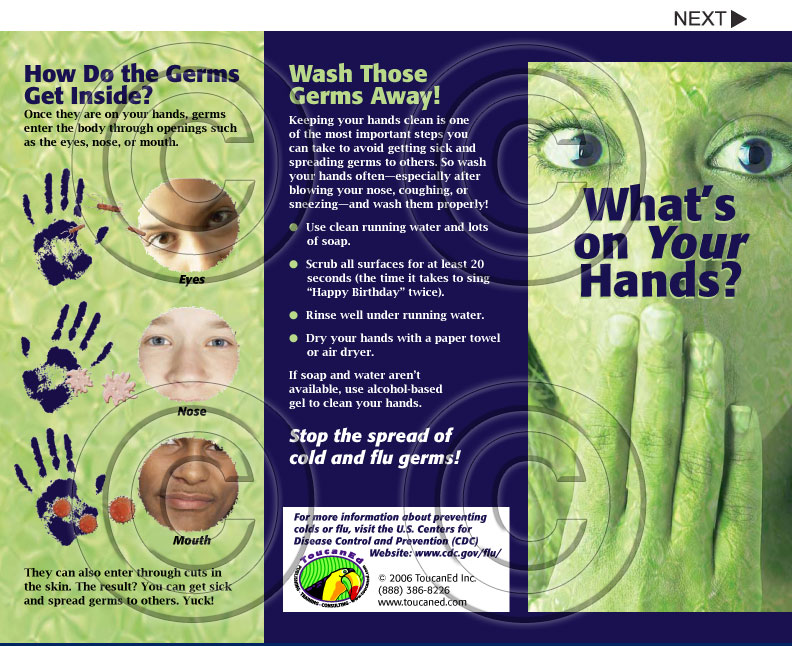
Example of pamphlet:

H. Procedures
First Activities (10’)
·
Saying with a friendly greeting to the
students when entering the classroom (embedded value: polite, caring).
·
Checking the presence of students (embedded
value: disciplined, diligent).
·
Linking the material / competencies that
will be learned with character.
·
With reference to the syllabus, lesson
plans and teaching materials, delivering grain character to be developed in
addition to those associated with the basic competence.
·
Students discuss the questions listed in
the textbook.
Main Activities (70’)
Exploration
In the exploration activities of teachers:
§ Provide
encouragement in the form of short functional text materials
"Advertising".
§ Discuss the matter with the student (Book: English
Teaching Material on short functional text "Advertisement".
§ Provide
opportunities for learners communicate orally or short functional text
presented on "Advertising".
§ Students are asked to discuss the example problems
in the book: English Teaching Material on short functional text
"Advertisement".
Elaboration
In the course of teacher elaboration:
§ Getting used students to make sentences of short
functional text "Advertisement".
§ Facilitating
students through giving the task, doing exercises that there are in the English
textbook to be done individually.
Confirmation
In the course of teacher confirmation:
§ Providing
feedback to the students by giving verbal reinforcement to students who have
been able to complete the task.
§ Giving
confirmation of the results of the work already done by the students through
sources from other books.
§ Facilitating
students to reflect to obtain a learning experience that has been done.
§ Motivating the students who lack motivation and
have not been able to follow the narrative text material.
Last Activities (10’)
§ The
students
are asked to to make a summary of the material regarding of short functional
text "Advertisement".
§ Students
and teacher reflecting on the activities that have been implemented.
§ The
students are given homework
related to short functional text materials "Advertising".
§ Delivering
lesson plan at the next meeting.

Tidak ada komentar:
Posting Komentar